When Patient Volume Grows Faster Than Your Cash: A Guide to Scaling Without Waiting
Written by Emily Davis
When Patient Volume Grows Faster Than Your Cash: A Guide to Scaling Without Waiting
The best problem a practice can have is too many patients. Full schedules. Referrals piling up. A waiting list longer than your front desk likes to manage.
It should feel like winning. And it does, for about two weeks. Then you start doing the math.
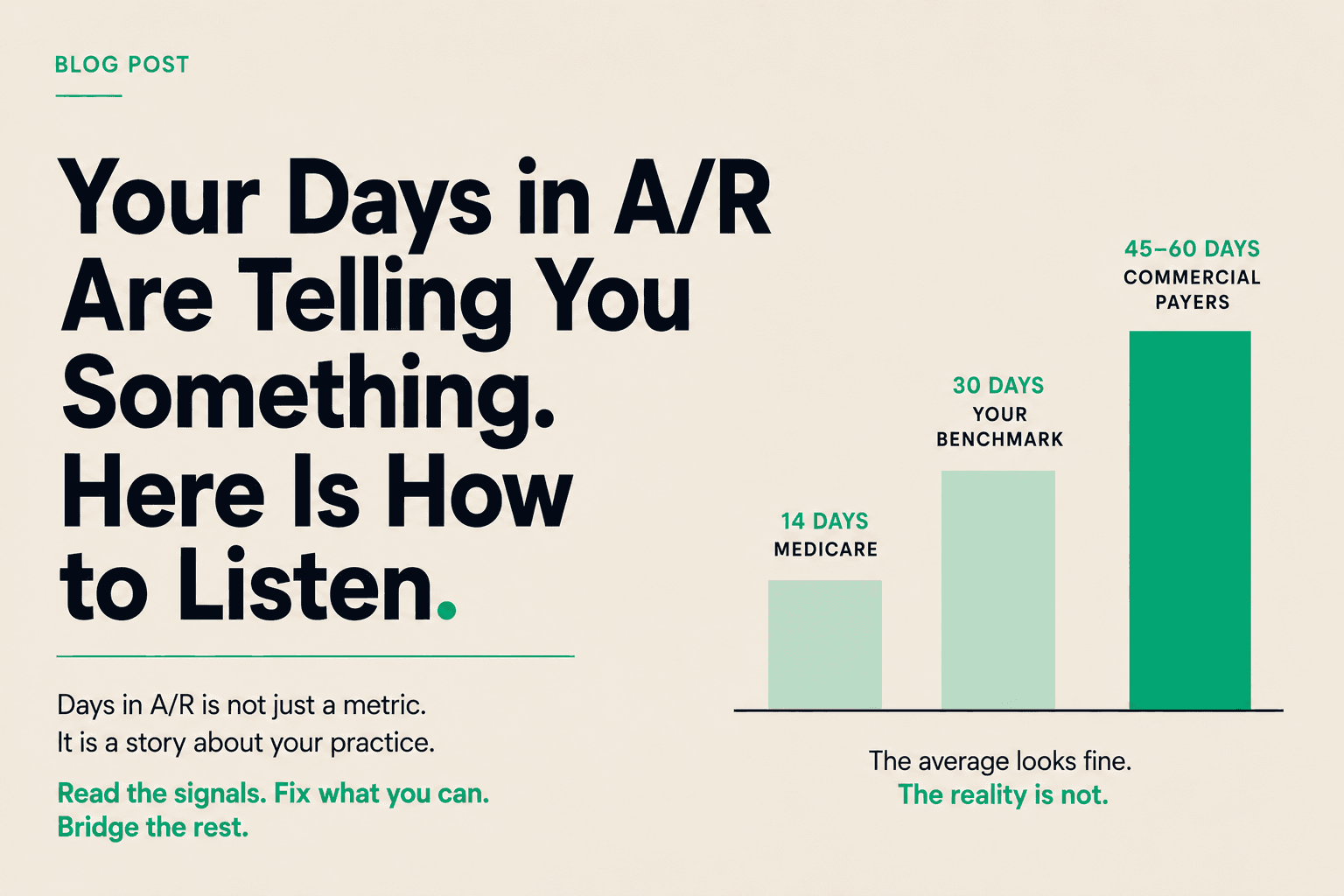
The new volume is real. The revenue is real. But the cash from that revenue arrives 45, 60, sometimes 90 days later. Your costs arrive immediately. Payroll is every two weeks. Supplies go on net-30 terms you actually have to pay. If you want to handle the volume properly, you need another provider, another exam room, possibly expanded hours. All of that requires spending money you technically have but cannot actually spend yet.
This is the practice growth paradox. Volume growth and cash growth are not the same thing, and they do not move on the same schedule.
## Why growth is a cash flow event
Every time your practice adds capacity or volume, you take on upfront costs before the revenue from that capacity reaches your account. That gap is not a sign that something is wrong. It is structural.
When you hire a new provider, you pay salary from day one. That provider bills claims that will not settle for 30 to 90 days. In the meantime, you are carrying two months of salary before a single dollar of that provider's revenue is in your bank.
On a $250,000 annual salary, that is roughly $40,000 to $60,000 in cash outlay before the math starts working in your direction. Once it does work, the economics are usually strong. A busy provider generates three to five times their compensation in revenue. But you have to get through the ramp.
The same math applies when you open an additional location, add a service line, or invest in new equipment. The cost is immediate. The payoff is deferred.
The decision most practices get wrong
When cash is tight during a growth phase, the instinctive response is to slow down. Wait until the cash reserves rebuild. Hire when it feels safer. Delay the expansion until the timing is better.
This feels conservative. Often it is just expensive.
Here is the calculation that gets missed. When you delay hiring a provider because cash is tight, you are not avoiding a cost. You are choosing between two costs.
Cost one: hire now, carry the salary gap for 60 to 90 days, accept some short-term pressure on operating cash.
Cost two: run understaffed for another quarter, turn away referrals, lose patients who go elsewhere, and watch your most experienced providers burn out covering the volume shortage.
Cost two looks like saving money because there is no invoice attached to it. But the revenue you did not capture, the referral relationships you let atrophy, and the provider you eventually lose to burnout are real costs. They are just harder to see on a spreadsheet.
What a healthy growth model actually looks like
Practices that scale well share a few common habits.
They model the ramp explicitly. Before adding capacity, they estimate the cash gap: how much goes out before revenue comes in, and how long until the new revenue covers the expense. This is usually 60 to 120 days for a new provider. Knowing that number removes the emotional component from the decision.
They treat submitted claims as working capital. At any given time, a growing practice has a meaningful amount of revenue in accounts receivable. That is not dead money sitting in a queue. It is capital with a known settlement timeline. Practices that understand this stop treating cash reserves as their only tool.
They separate operational cash from growth capital. Running payroll on your operating account is different from funding a new provider ramp. Mixing them means growth feels like a threat to stability when it should feel like a separate budget item.
They plan for the gap before they feel it. The worst time to figure out your capital strategy is when you are already under pressure. Practices that think about this in advance have options. Practices that wait until they are squeezed have fewer of them.
The three capital tools worth understanding
There is no single right answer for how practices fund growth. The right tool depends on your specific situation.
Cash reserves are the safest option and the most flexible. The limitation is that they are finite, and using them for growth means running with thinner cushions during a period when you need stability. Reserves built over years can be consumed in a single expansion cycle.
Practice loans and lines of credit give you access to capital beyond your reserves. They are well suited for large, defined capital needs: equipment, build-out, acquisition. The tradeoff is debt service on top of operating costs, plus covenants and collateral requirements that can restrict how you operate. They also take time to set up, which makes them a poor fit for fast-moving hiring decisions.
Receivables financing is less commonly used but often the best fit for bridging the ramp gap during growth. Rather than adding long-term debt or draining reserves, you access a portion of your existing A/R before the payer settles. The cost is transparent and tied to the actual settlement timeline. When the payer pays the claim, the advance reconciles. You paid a predictable cost to move money forward in time.
At Copay, the mechanics are straightforward: 0.75% for the first 10 days, a daily rate after that, at the individual claim level. No minimums. No contracts. If your payer settles in 20 days, you know exactly what it cost before you draw.
The reason this works well for growth situations is that it matches the cost to the actual gap. You are not taking on a five-year loan to fund a 60-day ramp. You are advancing specific revenue for the specific period it is in transit.
The practical starting point
If you are facing a growth decision right now, here is the exercise worth doing.
Take your average monthly claims volume. Multiply by your average days in A/R divided by 30. That number is your current A/R balance: revenue you have already earned but have not collected.
Now estimate the cash gap for your growth move. How much do you need to spend before the new revenue starts arriving? How long is the ramp?
Compare those two numbers. In most growing practices, the existing A/R balance is large enough that accessing even a fraction of it would fund the ramp comfortably, at a cost well below the revenue you would generate by moving faster.
The capital is usually already there. It is just sitting on the wrong side of the payment timeline.
Growth does not require waiting on payer schedules. It requires knowing your numbers, understanding your tools, and making the decision before the moment of pressure arrives.