Medicare Just Cut Payments to Independent Practices. Again.
Written by Emily Davis
Medicare Just Cut Payments to Independent Practices. Again.
CMS finalized the 2026 Medicare Physician Fee Schedule, and independent practices are taking the hit.
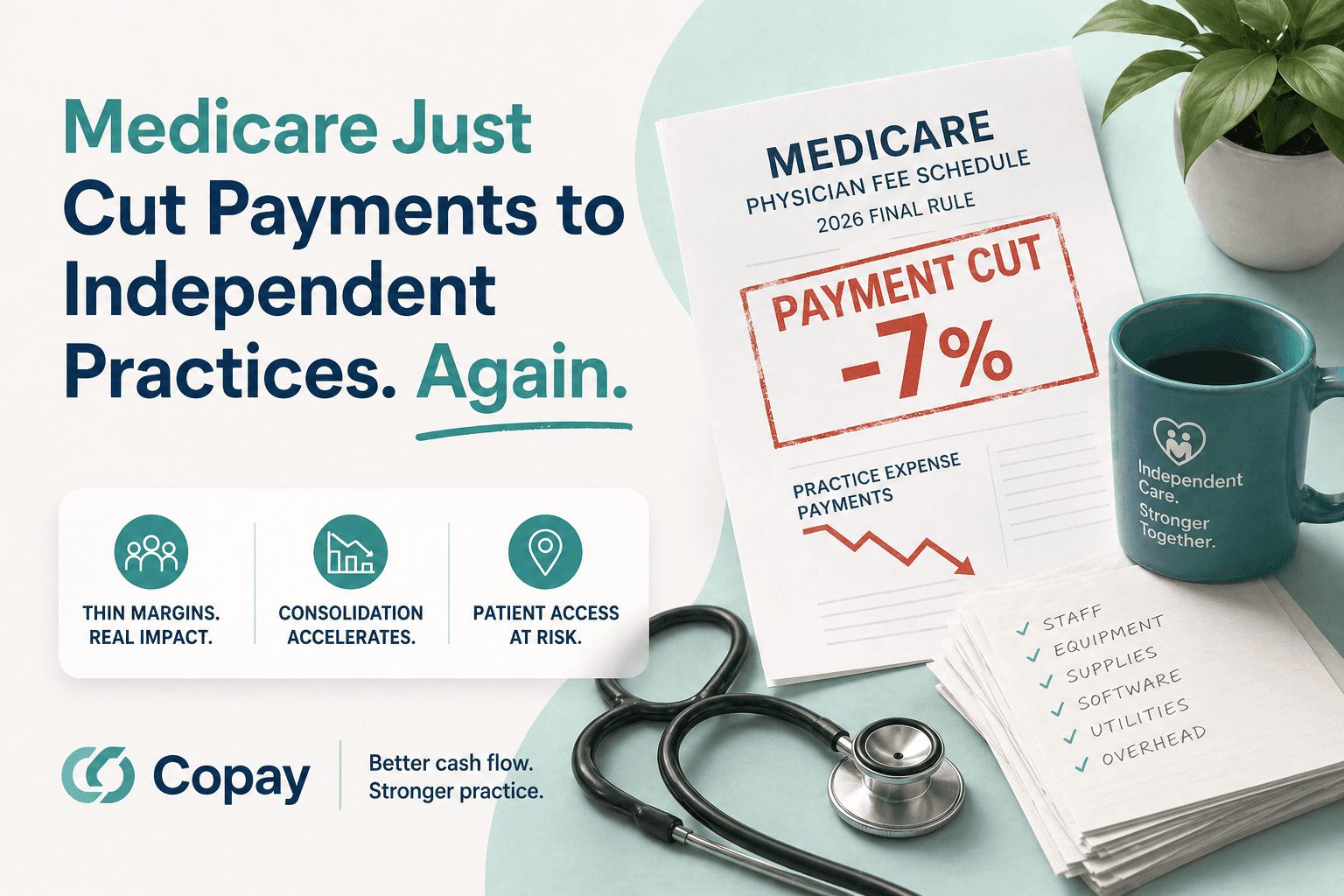
The cut targets practice expense payments for services performed in hospital settings by independent clinicians. CMS reduced the practice expense inputs used to calculate these payments. The result: physician payments for facility-based care will drop by roughly 7% overall, according to the AMA.
Practice expense payments cover overhead. Staff, equipment, software, supplies, utilities. The stuff that keeps a practice running. CMS says the cut is meant to stop overpaying hospital-employed clinicians and discourage hospitals from acquiring independent practices.
The problem: independent practices bear the cost, not hospitals.
What 7% actually means
Independent physician groups operate on thin margins. They do not have the cross-subsidies that large health systems use to buffer losses. A 7% reduction in practice expense reimbursement is not a rounding error. It forces real decisions.
Staff reductions. Higher patient volumes per clinician. Reduced compensation for providers, which makes recruitment harder. In some cases, practice closures.
The AMA called the impact "dramatic" and "unsustainable." That is not hyperbole. It is math.
The consolidation accelerator
CMS intended the cut to slow hospital acquisition of independent practices. It may do the opposite.
When independent practices face unsustainable reimbursement, they have limited options. They can cut costs until quality suffers. They can limit Medicare patient volume. Or they can sell to a health system that has the infrastructure to absorb the loss.
The AMA has tracked independent practice ownership for years. In 2012, 60% of physicians worked in private practice. By 2024, that number dropped to 42%. That is an 18-point decline in just over a decade. The drivers are well documented: inadequate payment rates, rising costs, administrative burden.
This cut adds pressure to a structure that was already cracking.
The patient impact
When independent practices close or consolidate, patients lose access points. Rural and underserved communities feel this first. Wait times increase. Continuity of care fragments. Costs often rise, not fall, because hospital-based care is more expensive than independent practice care for the same services.
CMS has a legitimate concern about hospital acquisition driving up costs. But the mechanism matters. Cutting practice expense reimbursements for independent clinicians does not fix the incentive structure for hospitals. It just makes independent practice less viable.
What practices are doing about it
Some are shifting to membership or cash-pay models. An Elation Health survey of 280 primary care clinicians found 27% of insurance-participating physicians have adopted membership or cash-pay models, and 18% are moving toward value-based payment structures.
These models can work. But they require infrastructure: technology built for the payment model, integration with the broader health system, and predictable cash flow. Without that foundation, even well-designed models create operational strain.
Other practices are looking at tools that close the cash flow gap between service delivery and reimbursement. When Medicare payments stretch out and then get cut, the timing problem becomes acute. Having access to working capital tied to submitted claims, rather than waiting on payer timelines, changes what is possible.
Where Copay fits
Copay works with independent medical practices to turn submitted claims into working capital before the payer pays. If your practice is facing tighter margins from reimbursement cuts and longer A/R cycles, we should talk.
The trend is clear. Independent practice is getting harder. The practices that survive will be the ones that adapt fast and manage cash flow precisely.