Medicare Payment Policy Is Moving (Again) and 2026 Is Getting Real
Written by Emily Davis
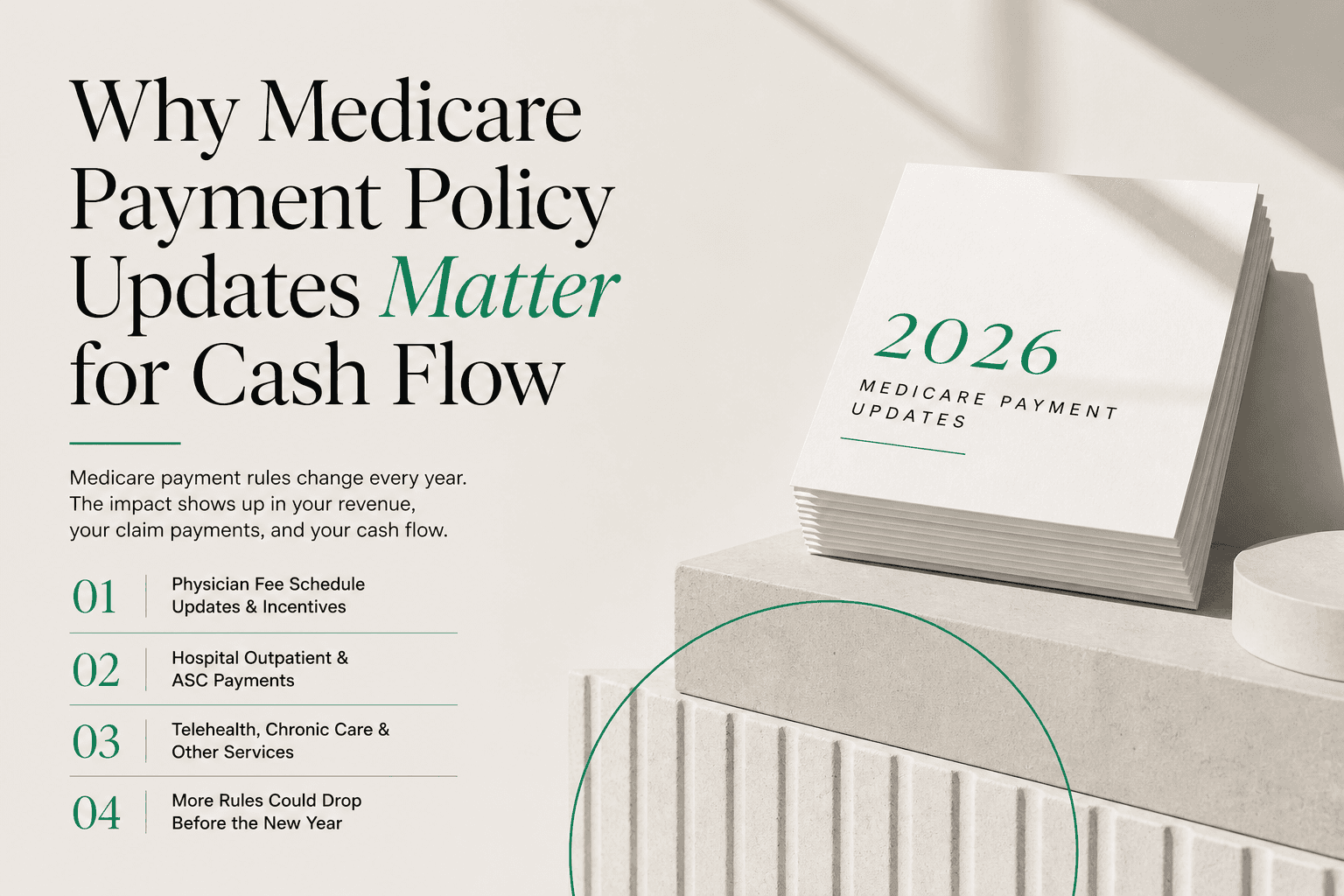
Why Medicare Payment Policy Updates Matter for Cash Flow
Medicare isn’t static. Every year, the Centers for Medicare & Medicaid Services (CMS) publishes final payment rules that update how services are valued and paid including physician services, hospital outpatient services, home health, and ambulatory surgical centers.
For providers and billing teams, these changes aren’t abstract policy tweaks. They translate into:
different allowed amounts on claims
adjusted payment rates that affect net revenue
shifts in which services get paid fastest
coding and documentation changes that affect denials and rejections
Because Medicare is such a large payer for many provider types, even small percentage changes in rates or payment policies can materially impact cash receipt timing and total reimbursement yield.
1) Physician Fee Schedule New Payment Structure and Incentives
CMS has released the final 2026 Medicare Physician Fee Schedule (PFS), which will take effect on January 1, 2026.
Key highlights include:
A final update to the conversion factor (CF) the core multiplier used to calculate payment for services under Medicare Part B.
Payment changes that include both increases for some services and reductions for others, meaning reimbursement per service can vary compared to 2025.
Modifications to how certain services (e.g., telehealth, behavioral health integration, chronic care management) are treated under the fee schedule.
Why it matters for receivables finance:
A revised CF directly affects the expected payment amount for Medicare claims which influences revenue projections and cash forecasting models.
Changes to service valuation can shift which claims are profitable versus those that require additional follow-up.
Providers must update billing systems and coder education ahead of the rule’s effective date to avoid routine under- or over-coding, which can slow payments or trigger denials.
2) Hospital Outpatient and ASC Payments. Slight Growth, Continued Complexity
CMS also finalized updates to the Hospital Outpatient Prospective Payment System (OPPS) and Ambulatory Surgical Center (ASC) payments for 2026.
Highlights include:
A modest increase in outpatient payment rates, tied to market basket updates.
Ongoing refinements to quality reporting measures and price transparency requirements.
Why it matters:
Even small payment increments or reporting changes can shift how quickly claims are adjudicated.
As outpatient delivery continues to grow, more revenue is tied to these payment policies, making the accuracy of coding and revenue integrity critical for predictable cash flow.
3) Telehealth, Chronic Care and Other Services Evolving Valuation
The 2026 rules also include changes in how certain services are valued:
Expanded support for telehealth payment policies, including updates that can streamline billing and reduce administrative friction.
Finalized adjustments to value codes related to chronic care and care management services, which may alter payment mix and timing.
Why it matters:
These changes affect not just whether a claim pays, but how predictably it pays.
Practices that rely on care management or telehealth services need to understand how the 2026 schedule affects payable amounts and coding guidance poor alignment can lead to claim rework.
4) More Rules Could Drop Before the New Year
While the Physician Fee Schedule and OPPS/ASC rules are finalized, CMS typically releases additional payment policies for other Medicare areas (such as home health prospective payment) later in the cycle. Providers should expect more final rules in late 2025 that will flesh out other parts of Medicare payment policy for 2026.
Why this matters:
Delayed payment rules can compress the time billing teams have to operationalize new policies, increasing the risk of claim errors and delays in first-pass payment.
A rolling release of rules means cash-flow planning must be adaptable throughout Q4 of the calendar year.
Bottom Line: 2026 Is a Payment Year That Requires Preparation
Medicare payment policy changes for 2026 reinforce a long-standing truth for provider finance leaders: payment predictability is not automatic, it must be engineered.
Providers that proactively educate, audit, and optimize around payment policy changes not only improve cash flow, they reduce administrative waste and strengthen overall financial resilience.