1 in 5 Americans Are Being Denied Care. Here's What It Means for Practice Cash Flow.
Written by Emily Davis
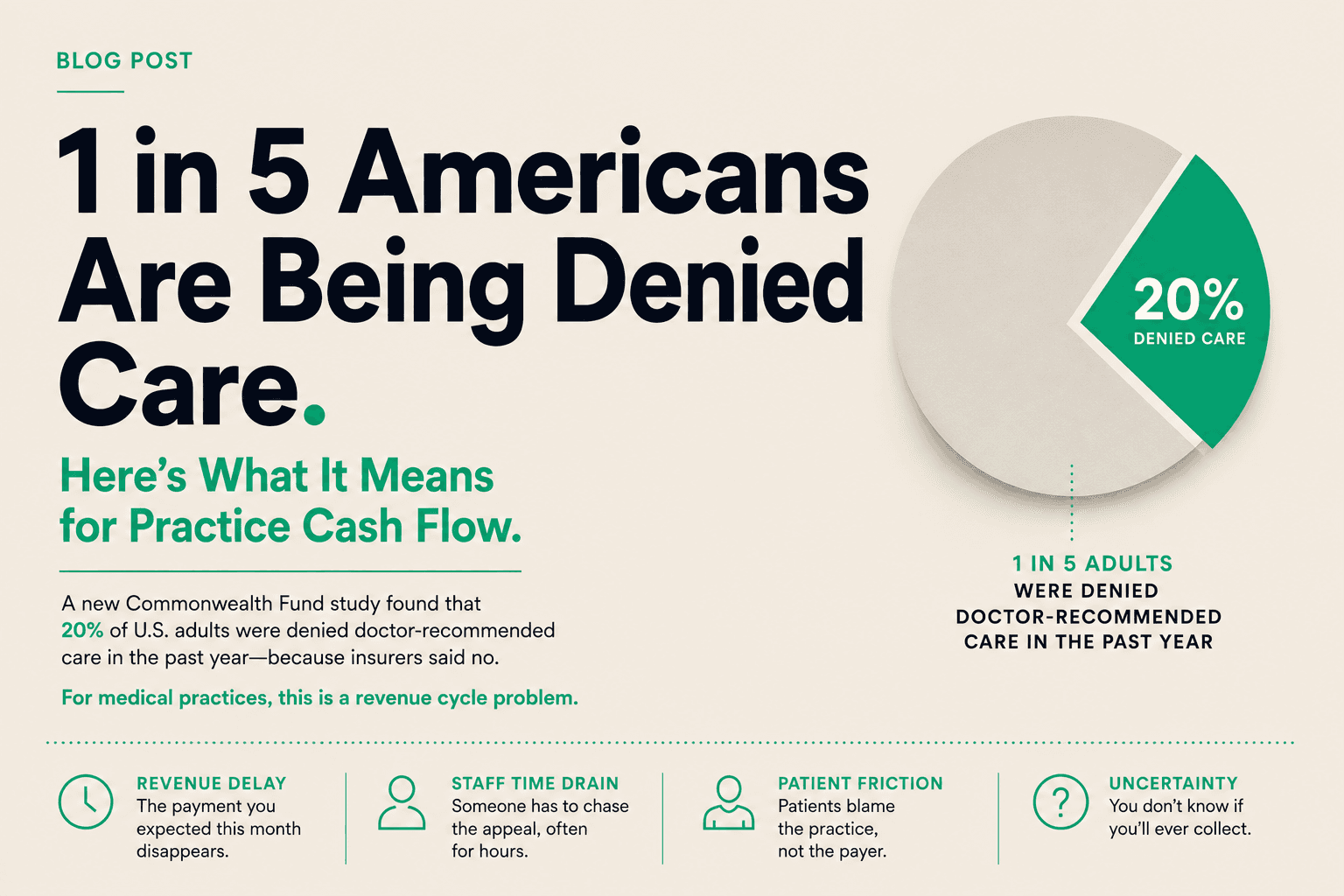
1 in 5 Americans Are Being Denied Care. Here's What It Means for Practice Cash Flow.
A new Commonwealth Fund study dropped last week, and the numbers are stark: 1 in 5 U.S. adults were denied doctor-recommended care in the past year. Not because the care wasn't needed. Not because it wasn't available. Because insurers said no.
For medical practices, this isn't just a patient access problem. It's a revenue cycle problem. And it's getting worse.
The Denial Crisis in Numbers
The Commonwealth Fund survey found that denial rates are climbing across the board:
- 20% of adults were denied care their doctor recommended
- Prior authorization delays are stretching into weeks, sometimes months
- Appeals processes are consuming staff hours that practices can't spare
Insurers defend their claims review processes as necessary cost controls. But for practices already operating on thin margins, every denial represents cash flow that may never arrive.
What This Means for Independent Practices
When a claim gets denied, the financial impact cascades:
1. Immediate revenue delay — the payment you expected this month disappears
2. Staff time drain — someone has to chase the appeal, often for hours
3. Patient friction — patients blame the practice, not the payer
4. Uncertainty — you don't know if you'll ever collect
For practices under $2M in monthly revenue, this uncertainty is existential. You can't budget. You can't hire. You can't invest in growth when you don't know if 20% of your expected revenue will actually show up.
The Cash Flow Squeeze
Here's what most people outside healthcare don't understand: practices deliver care today, but payment comes 30, 60, even 90 days later. Sometimes never. And when denials spike, the gap between "care delivered" and "cash in hand" widens.
A practice doing $1.5M per month might have $300K+ in claims outstanding at any given time. If 20% of those hit denial or delay, that's $60K in limbo. For a practice with payroll due Friday, that's not a spreadsheet problem. It's a survival problem.
What Practices Can Do
Tighten front-end processes. The best denial is the one that never happens. Verify benefits before the visit. Get prior authorizations early. Document everything.
Track denial reasons. Patterns reveal fixable problems. If the same CPT code gets denied repeatedly, something's wrong with how it's being submitted.
Speed up everything else. You can't control payer behavior. But you can control how quickly you convert clean claims into cash. That's where healthcare receivables financing comes in — turning pending claims into working capital so you can keep operating while the appeals process plays out.
The Bottom Line
The Commonwealth Fund study is about patient access on the surface. But underneath, it's about the financial fragility of the practices that serve those patients. When insurers deny care, they don't just hurt patients. They destabilize the entire revenue cycle that keeps practices open.
For practice owners and billing managers, the message is clear: denial rates aren't coming down anytime soon. The practices that survive will be the ones that build financial resilience into their operations — not just fighting every denial, but ensuring that delayed payments don't become business-ending events.
About Copay
Copay provides healthcare receivables financing for independent medical practices. We advance capital against submitted insurance claims so practices get paid now, not 30-60 days later. No debt. No patient involvement. Just faster access to money you have already earned.